
Added on: 16 November, 2026
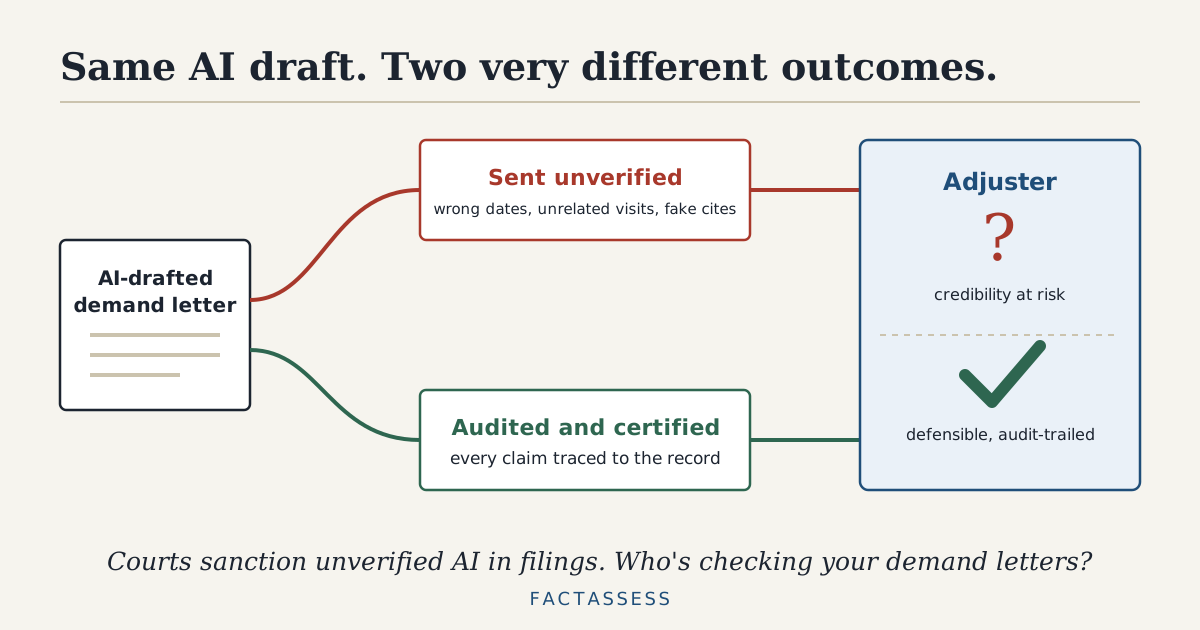
Let's be upfront about something. The AI sanctions making headlines are for court filings: briefs, motions and declarations. A demand letter goes to an insurance adjuster, not a judge. No court has sanctioned a firm for a demand letter.
So why should PI law firms care? Because the demand letter is the first document in a claim. It sets the damages narrative and the liability theory, it often feeds the complaint, and almost nobody checks it with the rigor a court filing now gets. The lesson from the sanctions isn't "don't use AI." It's "don't send unverified AI output out the door."
The Sanctions Record: How Big Is the Problem?
The numbers depend on who is counting, so we'll attribute each one.
- Reuters reported in September 2026 that courts had logged 1,395 cases involving AI-fabricated material in filings.
- Damien Charlotin's public database, as cited by legal-tech commentators, passed 1,000 US decisions earlier this year.
- Spellbook's October 2026 analysis counted roughly 1,492 US filings, including about 380 monetary sanctions and 163 disciplinary referrals.
- EDRM has tallied at least $145,000 in sanctions in the first quarter of 2026 alone.
Penalties now range from fines to suspension. In June 2026, the Ninth Circuit fined two immigration lawyers $2,500 each, suspended them for six months and ordered firm-wide AI-use certification for two years. The Sixth Circuit has imposed $15,000 per attorney. Nebraska issued what is reported as its first indefinite bar suspension tied to AI use.
Different trackers, different methods, same direction: up.
Two Cases Every PI Lawyer Should Know
Mata v. Avianca was a personal injury suit. Lawyers filed a brief citing cases ChatGPT invented and were sanctioned $5,000. It's still the case that made fake citations a common phrase for law firms.
Morgan & Morgan, one of the largest PI firms in the country, was reported to have cited eight fake cases out of nine in a product-liability motion. That's not a small-firm problem or a careless-solo problem. If it can happen at scale, it can happen anywhere.
In both cases, the courts' concern was the same. The problem was not that the lawyers used AI. It was that they filed its output without checking it.
Why the Demand Letter Is the Unchecked Upstream Document
A demand letter isn't a court filing, but it carries more weight than its status suggests.
It frames the case.
The adjuster's first read of your damages and liability theory comes from this document.
It anchors the number.
Treatment totals, future care and wage claims set negotiation ground that is hard to retreat from.
It often feeds the complaint.
If litigation follows, facts and phrasing move downstream. An error in the demand can become an error in a pleading, and then a filing is exactly where sanctions apply.
It's easy to impeach.
One wrong date, an unrelated visit counted as related, or a citation that doesn't exist can undercut your credibility for the rest of the file.
And unlike a brief, it rarely gets a second set of eyes. Court filings go through cite-checking. Demand letters often go out after a quick skim, because they're "just" a letter. AI drafting tools produce them in minutes, and vendors themselves describe drafts as roughly 85–90% ready. Nobody is assigned to the other 10–15%.
What Goes Wrong in an Unverified AI-Generated Demand Letter
In the audits we perform, the recurring problems are rarely dramatic. They're quiet (see our 8 common errors in AI-generated demand letters for the full list):
- Treatment dates or provider names that don't match the record
- Unrelated visits treated as related to the injury
- Prior injuries or pre-existing conditions not flagged
- Billing totals that don't add up across providers
- Invented or misattributed authority and standards
- ICD codes that don't match the diagnosis
This is why AI hallucination detection in legal documents isn't a software setting. It's a verification step, claim by claim against the source record.
So Who's Checking?
In most firms, the honest answer is: whoever has time. That is usually the paralegal, legal assistant or case manager, the same people many firms are tempted to cut because AI "does their job now."
It's worth saying plainly: these people are your verification layer. They know the file, the client and the adjuster. They notice when a treatment gap doesn't fit what the client told them. When AI drafts the letter, their role shifts from typing to checking, and checking takes time that a growing caseload doesn't leave. (We wrote about why some of the best insight in a PI firm comes from support staff.)
That's where an independent AI output audit for demand letters fits. It doesn't replace your team. It backs them up with a second, systematic review.
What an AI generated demand letter audit includes:
✓
Every factual claim traced to a page in the source medical record
✓
Hallucination and fabricated-authority checks
✓
ICD code and diagnosis matching
✓
Independent verification of treatment and damages math
✓
A certified, redlined document plus an audit trail memo showing what was checked and corrected
The audit trail matters. If an adjuster, opposing counsel or, down the road, a court asks how a figure got into your letter, you have a documented answer.
The Takeaway for PI Law Firms
AI drafting is here to stay, and it's a genuine advantage. The firms that benefit most will be the ones that treat AI output as a draft, not a deliverable, and build verification into the workflow before the next headline lands.
You can't control what courts decide. You can control whether the first document in your claim has been checked.
Sources: Reuters (Sept 2026); Charlotin AI hallucination database; Spellbook (Oct 2026); EDRM Q1 2026 sanctions summary; Ninth and Sixth Circuit reports.
FAQs
Common questions from this post.
Your AI drafts it. We verify it.
Our Services


About Us
Get in Touch with Us!
© 2026 FactAssess. All rights reserved. Privacy Policy