
Added on: 16 September, 2026
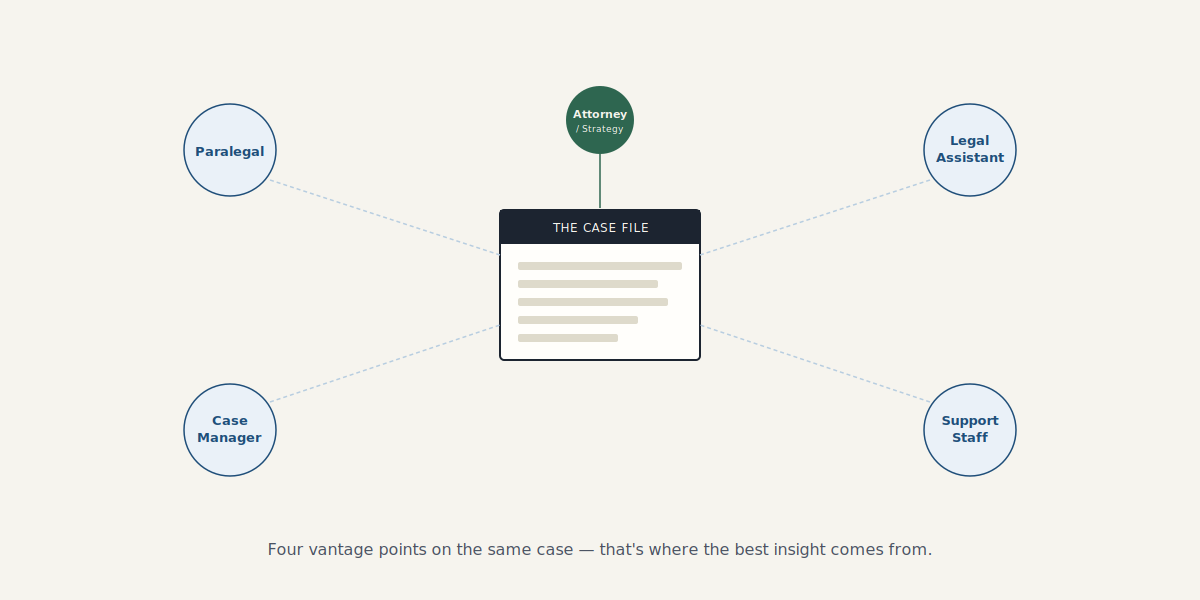
Ask an attorney, a paralegal, a case manager, and a legal assistant to describe the same case, and you'll get four different — and equally valid — answers. The attorney sees liability theory and litigation strategy. The paralegal sees the treatment gaps and missing records. The case manager sees the client relationship and what's actually realistic on timeline. The legal assistant sees the documentation trail and what's falling through the cracks administratively. None of these views is the "complete" one on its own. Put together, they're what actually wins cases.
That's not a new idea. What's new is the moment firms are having this conversation in: right as AI tools are automating a growing share of the drafting and document-review work non-attorney staff have traditionally owned. It's worth being deliberate about what that shift should — and shouldn't — change.
The Perspective Problem AI Doesn't Solve
AI tools are genuinely good at a specific kind of work: processing volume, extracting structured data, and drafting from a template. What they don't do is notice what a paralegal notices when something in a client's file doesn't add up, or what a case manager picks up on in a phone call that never makes it into the notes. Industry analysis on this exact question has converged on a consistent answer: AI is powerful at processing data, organizing records, and drafting documents, but it is not capable of replacing the skills that make paralegals and case managers indispensable to a firm's actual casework.
That's not a hedge or a reassurance — it's a description of two genuinely different kinds of work. AI processes what's already been captured. Non-attorney staff are often the ones doing the capturing: noticing the detail worth flagging, asking the follow-up question, sensing when a client's story doesn't match the paper trail. Multiple industry sources tracking this shift describe the emerging split in almost identical terms — courtroom preparation, attorney collaboration, and witness coordination all depend on experience and interpersonal skill, and these are precisely the parts of the job that grow more important as AI handles the rest.
Why Firms Lose Something Real When They Skip the Collaboration Step
The risk isn't that AI eliminates paralegal or case manager roles outright — most current analysis is fairly aligned that it doesn't. The risk is subtler: a firm leaning hard into AI-generated drafts can quietly start treating non-attorney staff as reviewers of AI output rather than sources of case insight in their own right. That's a meaningful demotion, even if no one frames it that way out loud.
The data on hiring and workforce trends backs up why that would be a mistake. The Bureau of Labor Statistics projects thousands of paralegal job openings annually through the next decade, and the consistent theme across legal industry analysis is that AI is not eliminating these positions — it is shifting them toward higher-value responsibilities. Firms that treat their support staff as a checkbox on an AI workflow, rather than as case strategists in their own right, are leaving exactly the value on the table that this workforce shift is supposed to unlock.
What Collaboration Actually Looks Like in Practice
Valuing non-attorney perspective isn't a culture-page platitude — it shows up in specific, practical habits:
Case strategy conversations that include the whole team, not just the attorneys.
The paralegal who built the chronology often has the clearest sense of where the record is thin. The case manager who talks to the client weekly often knows things about damages and impact that never made it into a formal record.
Treating AI-flagged issues as a starting point for discussion, not a final answer.
When an AI drafting tool or an audit process flags a gap — a missing provider, an unclear causation link — the next step is a conversation with the people who know the file, not just an automatic correction.
Building in time for the "does this feel right" gut check.
Support staff who've worked hundreds of similar cases develop pattern recognition that's hard to formalize but consistently valuable — the sense that a case is missing something, even before anyone can articulate exactly what.
Where FactAssess Fits Into This Picture
We built our AI Output Audit & Certification service around a version of this same principle: AI-generated output is a strong starting point, not a finished answer, and the judgment that closes the gap has to come from people who understand personal injury casework specifically — not a generic QA process bolted onto a drafting tool. Our reviewers apply exactly the kind of pattern recognition and case-specific scrutiny described above, checking AI-generated demand letters and medical chronologies against the source record before they reach an adjuster.
The parallel is intentional. Just as a firm's best insight often comes from the non-attorneys closest to a case, the most reliable check on AI-generated legal documents comes from reviewers who understand personal injury casework as practitioners — not from the AI tool grading its own homework.
FAQs
Common questions from this post.
AI can process a case file. Your team is what actually understands it.
Our Services


About Us
Get in Touch with Us!
© 2026 FactAssess. All rights reserved. Privacy Policy